

You Can’t Reform the Church Without Reforming Christians
 We talk a lot about reforming the church.
We talk about bishops, synods, structures, money, appointments, theological colleges and national strategy. Some of that matters enormously. Bad structures can frustrate good ministry. Bad appointments can do immense damage. Institutions can either serve the gospel or obstruct it.
But even if we fixed all of that tomorrow, we could still have a spiritually weak church. Because you cannot reform the church without reforming Christians.
One of the convictions running through Reforming and Renewing the Church is that renewal is usually much less spectacular than we imagine. It often begins quietly: ministers preaching the word week by week, churches praying, Christians teaching their children, sinners repenting, and ordinary believers learning to trust and obey Christ. The future health of the church is not determined only in synods and episcopal residences, but in pulpits, parish churches, theological colleges and ordinary local congregations where the word of God is taught and believed.
That may sound less exciting than institutional reform. But it is deeper.
Mature Christians are harder to blow off course
Ephesians 4 gives us a striking picture of what Christ wants his church to become.
He does not want Christians to remain infants, “tossed back and forth by the waves, and blown here and there by every wind of teaching”. He wants a mature body: stable, united in the faith, growing up into Christ, and building itself up in love “as each part does its work”.
That has obvious implications for reform. A church full of spiritually immature Christians will always be vulnerable to the next theological fashion. Every new slogan, cultural pressure or clever reinterpretation of Scripture can knock it sideways.
A mature church is much harder to destabilise.
So reform is not only about getting the right people into important positions. It is about helping ordinary Christians grow sufficiently deep roots that they can recognise false teaching, resist it, and speak the truth in love.
That is every-member ministry. The church is not renewed by a handful of professionals while everybody else watches.
A well-stocked larder is no use if nobody is hungry
But maturity requires feeding. The Church of England’s First Book of Homilies calls Scripture “that lively food of our souls”. That is a wonderful phrase. But the point I make in Reforming and Renewing the Church is that simply having access to good preaching is not enough. We need an appetite for it.
If we come to church listening only for the anecdote, the joke, the controversial remark, the political reference, or the moment when the preacher gets something wrong, we may hear plenty of words without being spiritually nourished.
The problem is not always that the food is bad. Sometimes nobody is hungry.
John Owen (1616-1683) is particularly searching on this. We need to “free our minds” to receive the word, he says. James tells us to put away what corrupts us and “receive with meekness the implanted word”. Our desires can become so noisy that they drown out what God is saying. We prefer entertainment for our passions to the edification of our souls.
That is a problem no synodical motion can solve.
Hearing is not enough
Nor is the aim merely to become better-informed Christians. Owen insists that we must “give up our souls in obedience to the word”. He warns that failure to obey God’s word is the field in which apostasy grows. That is worth dwelling on.
We sometimes think church decline begins when somebody publishes a heretical book, a bishop makes a disastrous statement, or a denomination changes its doctrine.
But apostasy can begin much more quietly. Christians hear the word and do not obey it. Sin is tolerated. Prayer becomes perfunctory. Scripture becomes familiar but no longer searching. We become experts at identifying other people’s compromises while protecting our own.
A church cannot be reformed merely by having a better doctrinal statement if the people who sign it are not being reformed by the doctrine they profess.
Today’s disciples are tomorrow’s leaders
This also matters for the future. One of the lessons from the history of Christian leadership is that strong leaders usually emerge from strong Christian formation.
In the early church, future leaders were first tested as faithful Christians. Formation took time. Character mattered as much as competence. Holiness could not be separated from skill. The same principle remains true.
We sometimes ask, “Where will the next generation of evangelical clergy come from?” A prior question is: where will the next generation of mature evangelical Christians come from?
Robust ministers do not normally appear magically at theological college. They are formed in families, youth groups, student groups and local churches. They learn to pray, read Scripture, serve, repent, endure, teach, listen and obey long before anyone puts a clerical collar around their neck.
If we want better ministers, bishops and theological leaders in twenty years’ time, we need better-formed Christians now.
Start closer to home
None of this means structures do not matter. They do. Doctrine matters. Bishops matter. Patronage matters. Colleges matter. Money matters. Synods matter.
But reform is never merely institutional. The deepest reform happens when the word of God reforms people.
So if we want a stronger church, one of the most revolutionary things we can do may be remarkably ordinary: open our Bibles, listen carefully when they are preached, repent when God’s word corrects us, obey what Christ commands, help one another grow up, and teach the next generation to do the same.
Because you cannot reform the church without reforming Christians.
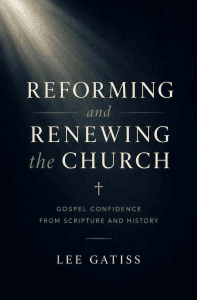
These themes are explored more fully in various chapters of my new book, Reforming and Renewing the Church: Gospel Confidence from Scripture and History, published by Church Society.
Lee Gatiss is the Director of Church Society