

Whitefield, Ryle and Machen: Three Ways to Contend for the Gospel
 What does faithfulness look like when the church is in trouble? There is a temptation to think there must be one correct strategy. Stay. Leave. Fight. Build. Ignore the structures. Capture the structures. Start something new. Recover something old.
Church history is rather less tidy than that.
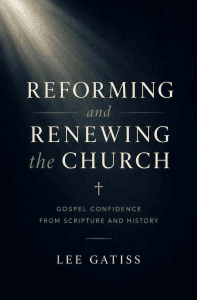
Three of the later chapters in my new book, Reforming and Renewing the Church, look at George Whitefield, J. C. Ryle and J. Gresham Machen. They lived in different centuries, belonged to different ecclesiastical situations, and made different strategic choices. But all three had to work out what it meant to contend for the gospel when the church around them was confused, resistant or compromised.
Their stories are worth hearing together.
Whitefield: rooted enough to be adventurous
George Whitefield was one of the great evangelists of the eighteenth-century revival. He was also much more positively Anglican than people sometimes remember.
J. I. Packer said that Whitefield regarded the religion he preached as a straightforward application of Anglican doctrine as defined in the Articles, Homilies and Prayer Book. Whitefield himself said that he was “a friend” to the Articles, the Homilies and the liturgy, and that if churches had not shut him out, he would gladly have continued to use them.
But doctrinal rootedness did not make him institutionally timid. When parish pulpits were closed to him, he went outside. He preached in fields and open spaces. Rather than waiting for sinners to come to church, he went looking for them in the “highways and byways”. The world became his parish, and the grey skies over London and Bristol became the roof of his cathedral.
He was what Augustus Toplady called one of the church’s “irregulars” — a kind of cavalryman, moving quickly and taking the gospel to places ordinary parish structures were not reaching. Others were the guardsmen and sentinels, serving faithfully in settled local ministry. Both were needed.
Whitefield teaches us something important: being deeply rooted can make us more adventurous, not less.
Innovation in method does not require innovation in doctrine.
Ryle: persistence can itself be a strategy
J. C. Ryle was different. He was not principally an itinerant evangelist. He was a parish minister, writer and eventually bishop. And he was enormously influential because he spent decades strengthening the evangelical cause from within the Church of England.
Ryle was confidently Anglican. He believed evangelical religion was not some foreign import into the Church of England but the religion of Scripture and of the Church’s own formularies. So long as the Thirty-nine Articles remained the doctrinal standard of the Church, he saw no reason why evangelical Christians should surrender their place within it.
He also understood the power of patient institution-building. He wrote around two hundred titles, selling millions of copies. He strengthened evangelical confidence, handed on a theological inheritance, and helped create the conditions in which evangelicals continued not merely to survive but to grow within the national church after his death.
Ryle was not naïve about the pressures evangelicals faced. He expected official frowns, ridicule, unpopularity and desertion. But his conclusion was not despair. As long as a faithful remnant remained, he said, there was no cause for “discouragement, despondency, or despair”. Rather, we should “stand firm and fight on.”
Ryle teaches us that persistence can itself be a strategy. Not every act of courage involves walking out of the door. Sometimes it means still being there decades later.
Machen: when tolerance becomes complicity
The American Presbyterian J. Gresham Machen’s story is more uncomfortable.
The famous argument in his classic book, Christianity and Liberalism (1923), was that historic Christianity and theological liberalism were not simply different versions of the same religion. They were different religions.
But the practical problem he eventually faced was not only liberalism. It was the tolerance of liberalism.
Some of the people who frustrated Machen most were themselves doctrinally orthodox. They believed in things such as penal substitution and the bodily resurrection. Yet when it came to the politics of the church, they were willing to accommodate those who denied such truths. That, in the end, became the deeper ecclesiastical problem.
Even then, Machen did not leap immediately to separation. He spent years hoping liberalism could be removed from his denomination. He wrestled seriously with whether evangelicals should continue supporting denominational agencies which were simultaneously funding faithful missionaries and spreading teaching hostile to the gospel. He acknowledged how complicated the problem was.
Eventually he concluded that conscience would no longer allow him to cooperate. He helped establish an independent missions board, was disciplined by the Presbyterian Church, and ultimately left to form what became the Orthodox Presbyterian Church.
And even that did not produce ecclesiastical paradise. Within a year, the new denomination split again. The anti-liberal alliance turned out to contain significant theological divisions of its own.
That is a useful warning against romanticising secession. But Machen’s deeper lesson remains: institutional peace is not worth preserving at the price of the gospel. There may come a point when accommodation ceases to be patience and becomes complicity.
No single tactic
So which of these men got the strategy right?
That is probably the wrong question.
Whitefield worked around obstructive structures while remaining doctrinally and consciously Anglican.
Ryle stayed within the structures, built for the long term, wrote, organised, encouraged and handed on the baton.
Machen stayed and contended until he concluded that his conscience would no longer permit continued institutional cooperation.
Three men. Three different situations. Three different strategies.
What they shared was more important than the tactics they adopted. They knew what the gospel was. They believed it was worth contending for. And they were willing to pay a price for doing so.
Church history does not hand us one universally applicable technique called “faithfulness”. Sometimes faithfulness means going round a blockage. Sometimes it means staying put for decades and building. Sometimes the moment may come when conscience forbids further cooperation.
The challenge is not simply to imitate Whitefield, Ryle or Machen. It is to possess the same clarity about the gospel, the same courage to act upon our convictions, and the same willingness to ask what faithfulness requires here and now.
The stories of George Whitefield, J. C. Ryle and J. Gresham Machen are explored more fully in chapters 19–21 of my new book, Reforming and Renewing the Church: Gospel Confidence from Scripture and History, published by Church Society.
Lee Gatiss is the Director of Church Society