

Despair Is a Bad Historian: Five Lessons about Reforming the Church
 It is easy to despair about the church.
Theological confusion, institutional failure, declining congregations, cultural hostility, and seemingly endless arguments can make our present difficulties feel unprecedented. We assume nobody has faced anything quite like this before—and that things can only get worse.
But despair is a bad historian. The church has been in serious trouble before. And history gives us some important lessons about how reform and renewal can emerge from such situations.
Here are five.
1. Reform usually begins locally, not nationally
We naturally look upwards. We watch synods, bishops, committees and national initiatives and conclude that nothing can change until something dramatic happens at the top.
History suggests otherwise. History suggests that real long-term change originates from the ground up more than from the top down, and that it is often resisted by “the powers that be”. That was the case with the Reformation, with the Evangelical Revival, and with the Anglo-Catholic movement.
Renewal is often quiet and almost imperceptible at first. Ministers preach the word week by week. Churches pray. Christians teach their children. Sinners repent and believe. Younger ministers enter difficult parishes and patiently rebuild.
National structures matter, of course. But churches are ordinarily revived locally before institutions are renewed nationally. The Church of England can be turned around one parish at a time.
2. The word of God is the engine of reform
John Henry Newman eventually concluded that “Reformation principles were powerless” to rescue the Church of England from liberalism.
But that misunderstands the Reformation.
Its fundamental reforming principle was not individualism, innovation, or the freedom to believe whatever we like. It was the supremacy of God’s word over the church. Our consciences are captive to Scripture, and it is God’s word which does God’s work in the world.
The existence of liberal bishops and theologians therefore doesn’t demonstrate that Protestantism has failed. The church has always needed reform because the church always needs recalling to the word of God.
3. Reform requires institutions as well as ideas
I always say that nothing happens without energetic individuals. But nothing lasts without solid institutions.
The Puritans understood this remarkably well.
They didn’t simply complain about the shortage of good preaching. They raised money, bought rights of patronage so they could appoint good ministers, supplemented inadequate stipends, funded lecturers in strategically important towns, and trained people for ministry.
In other words, they built things.
Faithfulness certainly requires good theology. But if we want good theology to spread, we also need churches, colleges, publishing, money, training, patronage and people willing to organise them.
Sometimes the most spiritual thing you can do for the future of the church is construct a spreadsheet and raise some money.
4. Serious error does not automatically mean it is time to leave
“When are we leaving?” has been the elephant in the room in many evangelical Anglican conversations for years.
There may be circumstances in which Christians have no alternative but to leave an institution. History certainly contains painful examples of that.
But history also warns us against treating secession as the obvious solution to ecclesiastical failure. The presence of theological error in a church is not in itself a signal for immediate surrender. If it were, Athanasius might have given up during the Arian controversy and the English Reformers might simply have abandoned the medieval church.
Sometimes error is not a summons to leave but a summons to reform.
5. Despair is a bad historian
Newman saw liberalism advancing in the nineteenth century and became convinced of its inevitable triumph. If liberalism gained a foothold in the Church of England, he thought, it was “sure of the victory in the event”. Protestantism lacked the resources to resist it, so ultimately he sought greater institutional security in Rome.
He saw some real dangers. But inevitability is a dangerous category in church history.
The early church survived persecution and heresy. The Reformation recovered the gospel in circumstances which hardly looked promising. Eighteenth-century evangelicals saw extraordinary renewal in a church which many regarded as spiritually moribund.
None of that guarantees that our plans will succeed. Christian confidence is not the same as optimism.
But neither Scripture nor history gives us permission for defeatism.
Christ has not ceased to build his church. His word has not lost its power. So our task is neither to pretend that everything is fine nor to declare everything hopeless. It is to preach, pray, contend, build, evangelise—and patiently get on with the work God has given us.
Despair is a bad historian. And it is an even worse strategy for reforming the church.
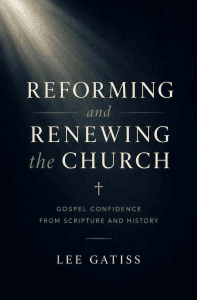
These are some of the themes explored more fully in my new book, Reforming and Renewing the Church: Gospel Confidence from Scripture and History, published by Church Society this September.
LEE GATISS is the Director of Church Society.