

BOOK REVIEWS: ‘The Anxious Generation’ & ‘Unlocked: The Real Science of Screen Time’
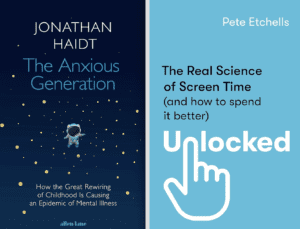
Robin Barfield reviews Jonathan Haidt's: The Anxious Generation: How the Great Rewiring of Childhood is Causing an Epidemic of Mental Illness.
and Pete Etchells book: Unlocked: The Real Science of Screen Time (and how to spend it better).
The best way to sell books to parents is to scare them, and new technology is an easy fear to play on. Research has shown that religious parents have a higher emotional reaction to new technologies. Those of us who remember the scare stories of violent video games in the 1990s will know the importance of being cautious and nuanced when it comes to the unfamiliar changes which come with raising the rising generation. As Bob Dylan sang, “Come mothers and fathers throughout the land/ And don’t criticize what you can’t understand”. This review will cover two recent books on smart phones and social media; one which is subtle, thoughtful, nuanced and constructive; and the other which hammers away at an unspecified issue and feels cynically marketed to religious parents. I will let the reader decide which book is being referred to in each case.
Jonathan Haidt is a well know social psychologist, commentator, and author. He has previously written several books which have sold well amongst Christian parents. His key thesis here is that we have moved from a ‘“play-based childhood” to a “phone-based childhood”’ (7), children are being over-protected in the real world and under-protected online; screens are causing an epidemic of mental illness, a ‘great rewiring’ of children’s brains. These are big claims and Haidt spends the next twelve chapters defending and making practical suggestions. Having laid out in chapter 1 graph after graph which demonstrates a correlation between smart phone introduction and an increase in mental health problems, part 2 describes the decline in risky play and has some interesting and useful observations. In part 3, Haidt claims that smart phones cause sleep and social deprivation which harms girls far more than boys, before suggesting that spiritual practices of silence and stillness need to be reintroduced. Part 4 makes recommendations for collective action from various groups. Haidt is looking to incite a revolution based on his prior chapters. I am sure that this book will convince many parents to act and there have already been many discussions around this work. Will it be the right action and response, or will Christian parents end up misjudging the impact of new technology by demonising it in the way previous generations have?
Pete Etchells book Unlocked, is a fascinating partner volume. Etchells is Professor of Psychology and Science Communication at Bath Spa University, where he studies the short- and long-term behavioural effects of digital technology. His volume has no single argument; he has not come to praise or to bury smart phones, but to examine the evidence that exists. This means that Etchells considers the arguments for and against the claims that smart phones cause insomnia, problems with attention, addiction and the benefits of digital detox suggestions. His careful weighing up of evidence on both sides comes from a calm and non-anxious presence in the midst of a torrid sea.
One of the most helpful parts of Etchells book is his description of the arguments that smart phones cause poor mental health as a ‘jingle-jangle argument’ (47). That is, are we using one term to describe many things and many terms to describe one thing. Haidt appears to be unaware of this challenge. Etchell’s point is that we need to be far more specific in what is being compared: what do we mean by ‘smart phones’, devices, social media (which ones and how?), screens, contact with dangerous individuals? And what do we mean by poor mental health: anxiety, depression, self-harm, and so on? “Using ‘social media’ when we’re actually interested in Instagram, Mastodon or Facebook is a jingle problem, whereas using phrases like ‘social media’, ‘social networking sites’ and ‘screen time’ interchangeably when we’re talking about one thing is a jangle problem.” (48).
Etchell’s book does not provide four simple solutions for a concerned parent, but simple solutions are rarely the solution to complex problems. What it does is provide information for parents to make decisions based on their individual children and the setting they are in. Undoubtedly Haidt’s book will sell more; it has already caused more of a stir. This does not mean that it is better or more helpful for parents. The dangers and potentials for discipleship and evangelism in a smart-phone-era are enormous. For Christian parents sifting the wisdom the world has to offer on new technology and parenting is critical.
Robin Barfield, Oak Hill College, London, UK