

BOOK REVIEW: Timothy Keller: His Spiritual and Intellectual Formation
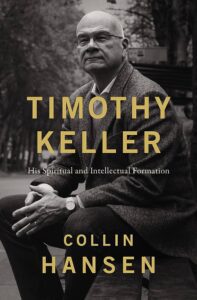
This is the best book I’ve read this year. Once I picked it up, I struggled to put it down and went through it front-to-back in three days. It is not a biography in the traditional sense. It does chart aspects of Tim and Cathy’s story but is more interested in tracing the formative influences that shaped their lives and ministry.
Hansen briefly narrates elements of Keller’s upbringing in Allentown, Pennsylvania, but quickly moves to describe the impact of Tim’s university days – his conversion, and the role of the InterVarsity Christian Fellowship in moulding his appetite for Scripture. In their early twenties the Ligonier Valley Study Centre, under the direction of R. C. Sproul, provided a model of persuasive apologetics. During their time at Gordon Conwell, influences included Meredith Kline, Elisabeth Elliot, Edmund Clowney, and Roger Nicole. The latter modelled the ability to disagree without being disagreeable. Richard Lovelace taught Tim about the spiritual dynamics of revival.
After attending Gordon Conwell, the Kellers took up their first pastorate in small rural Hopewell, Virginia (1975-1984). During this time Keller found great help in the writings of the Puritans as those who understood the human condition and taught him to speak with empathy and insight, addressing the heart, not just behaviour.
In 1984, Tim accepted the invitation to join the faculty at Westminster Theological Seminary. His mentor, Edmund Clowney, had taught him a biblical theological approach to preaching Christ from all the Scriptures. Harvie Conn taught him how to contextualise the gospel, with a special interest in the city. This meant, among other things, learning to bring together gospel proclamation and social justice, something that had divided liberals and evangelicals up until this point. These influences were steadily moving Tim and Cathy towards urban ministry, though, as Hansen points out, Tim was hoping to find someone else to take up the opportunity in New York.
In 1989 Tim and Cathy moved to launch Redeemer, at a time when life in New York was rough – rates of violent crime had quadrupled in the previous decade. Nobody held out much hope that such a venture could be successful. Keller learned that gospel preaching provided edification and evangelism. In the wake of 9/11 Keller wrote Reason for God as he was engaging with people’s real and deep questions. Cultural commentators such as Charles Taylor, Philip Rieff, Robert Bellah, and Alasdair MacIntyre, proved helpful as Keller engaged the presuppositions and worldview of his hearers.
Striking, throughout Hansen’s work, is Keller’s humility and his passion to go deeper in his relationship with Christ. He never sought the fame that came his way. He longed to know more of the Saviour in prayer. He engaged thoughtfully with his culture, but fundamentally he knew revival came from increased dependence on the workings of God’s Spirit. Keller knew that his character was more important than his gifting – something his favourite mentors (modern or puritan) had taught him. This book will not give you a blueprint for a successful ministry. Nor will it provide juicy new details of Tim’s life. It will inspire you to pursue a deeper love for the Saviour. Hansen has done something of which Tim would approve. He has provided not just interesting information but has moved the heart. Even more remarkably, Hansen’s work doesn’t just increase admiration for Tim Keller (though it does); it has served to increase the desire for the Saviour.
Timothy Keller: His Spiritual and Intellectual Formation by Collin Hansen is published by Zondervan Reflective, 2023 (ISBN: 9780310128717 pb, 306pp)
Martin Salter, Grace Community Church, Bedford